

y viviéramos solo tres días de veranos.
Tres días así contigo los llenaría
de más placer que el que cabe
en cincuenta años…»
John Keats
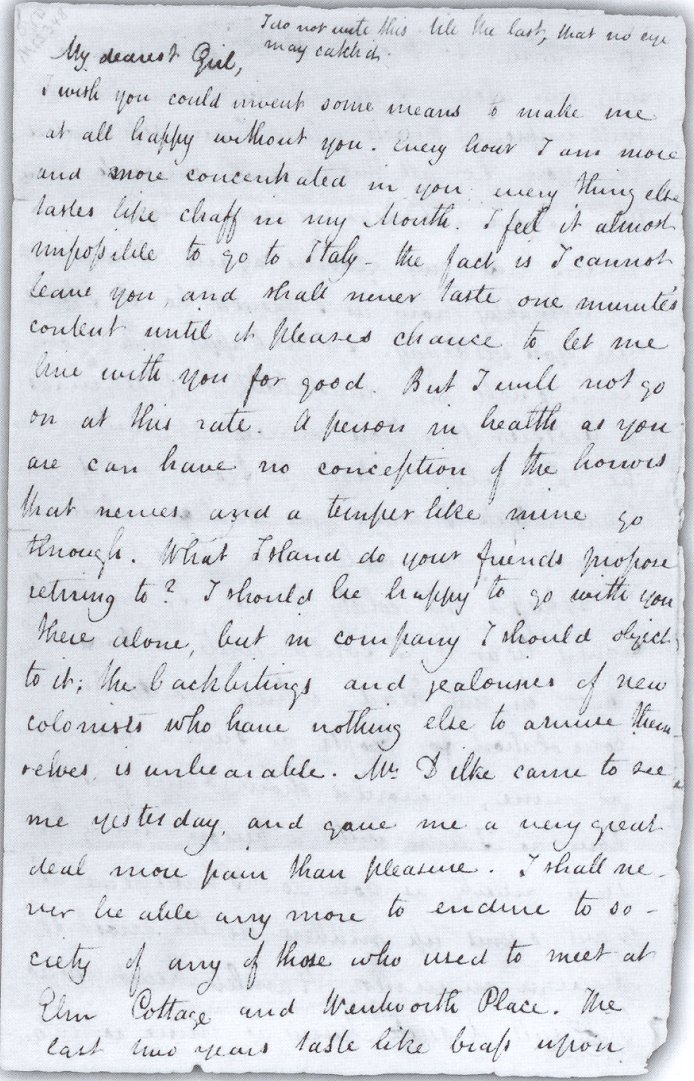
My dearest lady,
I am now at a very pleasant cottage window
looking onto a beautiful hilly country,
with a view of the sea.
The morning is very fine.
I do not know how elastic
my spirit might be,
what pleasure I might have in living here
if the remembrance of you
did not weigh so upon me.
Ask yourself, my love, whether you are
not very cruel to have so entrammelled me,
so destroyed my freedom.
For myself, I know not how to express
my devotion to so fair a form.
I want a brighter word than bright,
a fairer word than fair.
I almost wish we were butterflies
and lived but three summer days.
Three such days with you
I could fill with more delight
than 50 common years could ever contain. »
When you can confess this in a letter
you must write immediately
and do all you can to console me in it,
make it rich as a draft of poppies
to intoxicate me,
write the softest words and kiss them
that I may at least touch my lips…
BY JOHN KEATS
My sense, as though of hemlock I had drunk,
Or emptied some dull opiate to the drains
One minute past, and Lethe-wards had sunk:
‘Tis not through envy of thy happy lot,
But being too happy in thine happiness,—
That thou, light-winged Dryad of the trees
In some melodious plot
Of beechen green, and shadows numberless,
Singest of summer in full-throated ease.O, for a draught of vintage! that hath been
Cool’d a long age in the deep-delved earth,
Tasting of Flora and the country green,
Dance, and Provençal song, and sunburnt mirth!
O for a beaker full of the warm South,
Full of the true, the blushful Hippocrene,
With beaded bubbles winking at the brim,
And purple-stained mouth;
That I might drink, and leave the world unseen,
And with thee fade away into the forest dim:Fade far away, dissolve, and quite forget
What thou among the leaves hast never known,
The weariness, the fever, and the fret
Here, where men sit and hear each other groan;
Where palsy shakes a few, sad, last gray hairs,
Where youth grows pale, and spectre-thin, and dies;
Where but to think is to be full of sorrow
And leaden-eyed despairs,
Where Beauty cannot keep her lustrous eyes,
Or new Love pine at them beyond to-morrow.Away! away! for I will fly to thee,
Not charioted by Bacchus and his pards,
But on the viewless wings of Poesy,
Though the dull brain perplexes and retards:
Already with thee! tender is the night,
And haply the Queen-Moon is on her throne,
Cluster’d around by all her starry Fays;
But here there is no light,
Save what from heaven is with the breezes blown
Through verdurous glooms and winding mossy ways.
I cannot see what flowers are at my feet,
Nor what soft incense hangs upon the boughs,
But, in embalmed darkness, guess each sweet
Wherewith the seasonable month endows
The grass, the thicket, and the fruit-tree wild;
White hawthorn, and the pastoral eglantine;
Fast fading violets cover’d up in leaves;
And mid-May’s eldest child,
The coming musk-rose, full of dewy wine,
The murmurous haunt of flies on summer eves.
Darkling I listen; and, for many a time
I have been half in love with easeful Death,
Call’d him soft names in many a mused rhyme,
To take into the air my quiet breath;
Now more than ever seems it rich to die,
To cease upon the midnight with no pain,
While thou art pouring forth thy soul abroad
In such an ecstasy!
Still wouldst thou sing, and I have ears in vain—
To thy high requiem become a sod.
Thou wast not born for death, immortal Bird!
No hungry generations tread thee down;
The voice I hear this passing night was heard
In ancient days by emperor and clown:
Perhaps the self-same song that found a path
Through the sad heart of Ruth, when, sick for home,
She stood in tears amid the alien corn;
The same that oft-times hath
Charm’d magic casements, opening on the foam
Of perilous seas, in faery lands forlorn.
Forlorn! the very word is like a bell
To toll me back from thee to my sole self!
Adieu! the fancy cannot cheat so well
As she is fam’d to do, deceiving elf.
Adieu! adieu! thy plaintive anthem fades
Past the near meadows, over the still stream,
Up the hill-side; and now ‘tis buried deep
In the next valley-glades:
Was it a vision, or a waking dream?
Fled is that music:—Do I wake or sleep?


Como en la entrada anterior, siento no saber inglés, pero merece la pena por el primer trocito traducido, que es precioso.
Un saludo
Me gustaMe gusta
La canción bellísima. Por la música llena de sentimiento melancolía y seguramente tristeza, se me ocurre una oración, una implorante súplica imposible a Dios.
Un saludo
Me gustaMe gusta
Gracias!
Aqui te transcribo el poema que sugiere la cancion
La fuente es http://www.wingmakers.com/
y el poema, en especial es el 24: poetrychamber24 «A Fire For You»
aqui va:
«Por esto, el día más corto del año ,
He viajado a las Grandes Llanuras
para encender el fuego para usted.
El aire de la noche es fría como un sótano
corte de las piedras antiguas.
Pero encontré un poco de madera entre las llanuras desiertas
sepultado bajo las hierbas y la suciedad,
escondido como las hojas
que se había convertido en el suelo.
Después limpié la madera con la mano – la tierra bajo
mis uñas y el tejido de la tela de mi
Envié una llama
quemado por el mero hecho de pensar en ti.
Y la madera se convirtió en fuego.
Había estrellas ermitañas que se reunieron
para hacerme compañía .
Su espíritu estaba allí también
en medio de las llamas del fuego .
Nos reímos de el significado profundo del cielo
y sus amplias formas.
Maravillado por el espejo plano de la llanura
que envía tan poco hacia el cielo,
al igual que los corazones de los niños negados
un cierto tipo de amor.
Jugaste con los espíritus
cuando eras joven entre estos campos.
Usted no sabía sus nombres a continuación .
Yo fui uno .
Incluso sin un nombre, o el cuerpo,
Vi su mirada, implacable a las cosas
que batido entre la
dos espejos del cielo y la llanura .
Creo que fue aquí también
que usted aprendió a hablar con Dios.
No con tantas palabras como usted ahora está acostumbrado ,
pero estoy seguro de que Dios escuchó su vida
y se reunieron alrededor de su fuego
para el calor y el significado.
En las llanuras desiertas encontró lo diferencian
de todas las cosas que faltan .
Querido espíritu , he celebrado esta vigilia durante tanto tiempo,
incendios tendientes cuyo propósito se me ha olvidado .
Creo que el calor fue uno .
Tal vez la luz era otra .
Tal vez la esperanza era el más fuerte de estos.
Si alguna vez te encuentro en mi fuego,
construido por las manos
que saben que su piel final,
entre las láminas del cielo y la llanura ,
Voy a recordar su propósito.
En campos yermos
que durante mucho tiempo han sido abandonados por la mano del hombre
Voy a recordar .
En el ojo más profundo de ti
Voy a recordar .
En la noche más larga que
Voy a recordar .
Por esto, el día más corto del año ,
He viajado a las Grandes Llanuras
para encender el fuego para usted…»
Me gustaMe gusta